Stress‑test your filing before opposing counsel does.
Upload the draft and the papers it answers. Three adversaries attack it, and you get one memo on what to fix.
A public court filing, run through Second Check as filed: the Sohex opposition, tested against the motion it answers.
Read as · Opposition to motion to set aside clerk's entries of default · San Diego County Superior Court
Code of Civil Procedure section 587 requires only that a request for entry of default be accompanied by proof that a copy was mailed to the defendant's attorney of record after filing; it does not require advance notice of an intent to seek default, and expressly provides that "[t]he nonreceipt of the notice shall not invalidate or constitute ground for setting aside any judgment."
Defendants' Motion turns on a single exchange: Sohex's counsel invited a response by 5:00 p.m. on August 18, and Sohex requested default the morning of August 17, one day earlier.
A default the client's own delinquency has already earned is not "caused," within the meaning of section 473, subdivision (b), by an attorney's later tactical choices.
Likely denied
The problem
You cannot read your own brief cold.
By the time a draft is ready, you know what every sentence is meant to say. The other side reads only what it does say. They find the hedged line in the declaration, the case that holds less than the brief claims, and the argument from their motion that your opposition never answered.
The judge finds the same things, often at the hearing, when it is too late to fix them.
The adversaries
Three adversaries, each paid to make the filing lose.
None of them compliments the writing. This is what each wrote about the Sohex opposition.
Opposing counsel
Argues from the other side's own papers.
Reply: a rule stated in a lawyer's own email is not authority, and Shapell turns on knowledge of counsel's identity, not a live deadline.
The bench
Has read both sides, and asks what the hearing will.
Quantify the prejudice. What fees, what date was the case management conference, what evidence is lost, and what would Sohex be unable to do in August 2026 that it could have done in June?
Procedural review
Works the statutes, the local rules and the Rules of Court.
Section 587 compliance and absence of prejudice are defensive points that defeat nothing standing alone; a defendant showing excusable neglect wins despite perfect section 587 compliance.
The memo
What the memo contains.
Who wins on these papers, what to keep, what loses the motion, what the record is missing, and what the other side files next. In this order, with the Sohex sample’s own words under each heading.
Executive assessment
On these papers the motion to set aside is likely to be granted and this opposition largely to fail…
Strongest features
The pre-retention delinquency is undisputed and documented by the movants' own declaration.
Principal weaknesses
This treats attorney fault as needing to be the sole or original cause. Benedict, which the brief itself cites…
Missing facts and evidence
Mr. Silva, you set the hour. Why did you not wait the thirty hours you had told opposing counsel you would wait?
Likely reply arguments
Mandatory relief turns on cause in fact, not sole cause…
Procedural and presentation issues
Contradicted by the filing's own Section II.C and Exhibit C: defense counsel responded in writing at 5:24 p.m. on August 14…
Prioritized recommendations
Rewrite Section IV.E to abandon the sole-cause theory: concede the Montez affidavit is facially sufficient under Martin Potts and argue instead…
Bottom line
This opposition is strongest where it is narrowest: the undisputed fifty-six day delinquency, fifty of it pre-retention…
Delivered
On screen, and as a PDF.
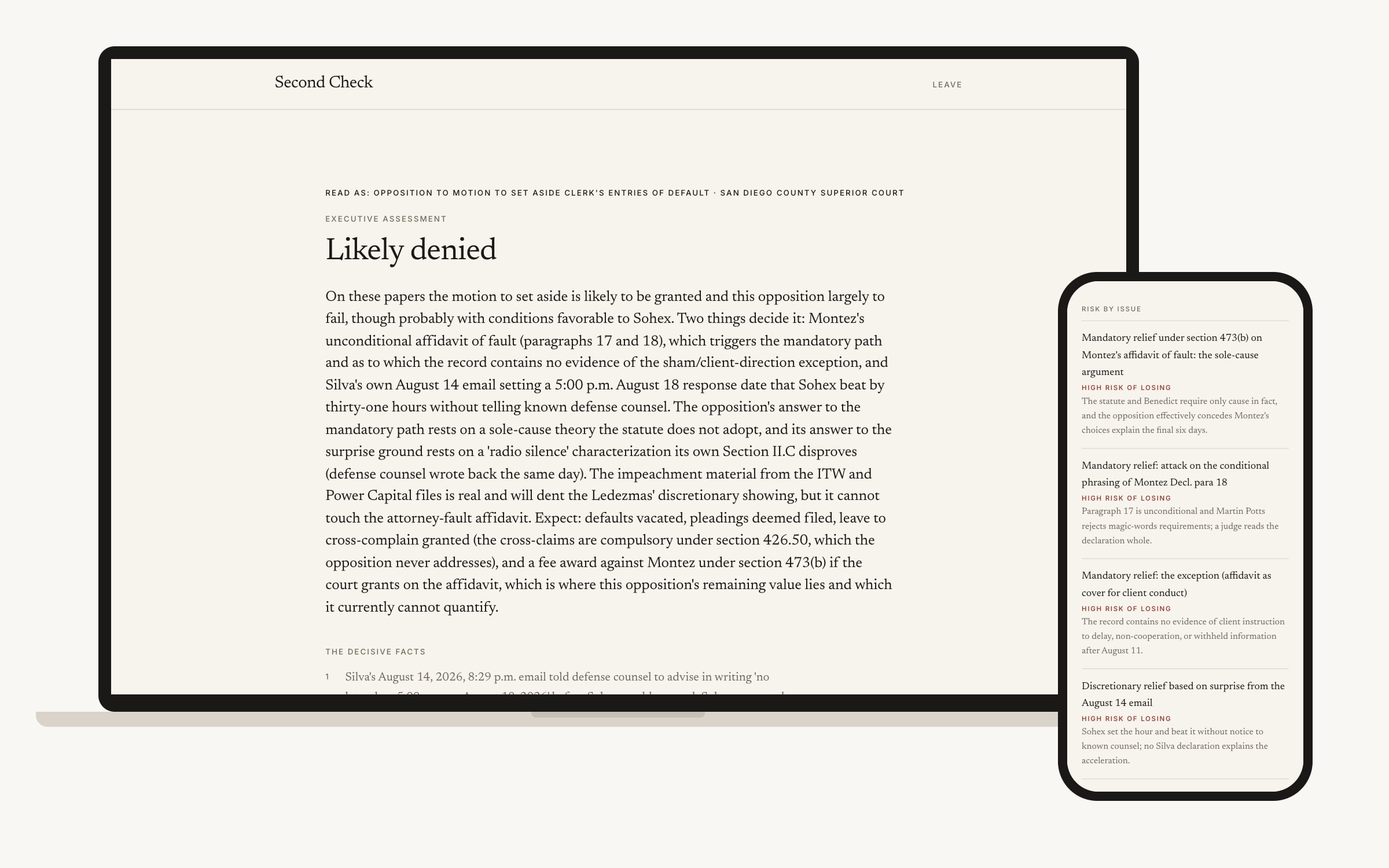
It opens on the verdict, likely granted, at risk or likely denied, with the facts that decide it and the risk on each issue. Every citation is checked against its source.
Who it is for
For California litigators in solo and small firms.
For the lawyer who drafts the opposition and argues it, with no one down the hall to read it first. Local rules are loaded for the San Diego, Orange, Riverside and Los Angeles superior courts and the Southern District of California.